The problem with manufacturer-tied monitoring
Every major lift manufacturer now offers a monitoring product. Otis ONE. KONE 24/7 Connected Services. Schindler Ahead. TK Elevator MAX. From the manufacturer's side, this makes commercial sense – monitoring is a high-margin service layer on top of the hardware they already sell.
From the building owner's side, the model has a structural problem: each platform only sees the lifts from its own manufacturer.
For a single-brand portfolio, this is acceptable. For everyone else – which is most of the market – it produces a fragmented operational picture. Three buildings, three platforms, three sets of credentials, three reporting formats, three different definitions of "fault" and "uptime." The data exists, but it never integrates. The portfolio view is reconstructed manually, building by building, every time a board report is due.
There is a deeper issue beneath the operational friction. Manufacturer monitoring is built around the manufacturer's commercial relationship, not the building owner's operational reality. The data is owned by the manufacturer. The reporting is filtered through the manufacturer's interpretation. The service insights that emerge are, predictably, ones that point back toward the manufacturer's service offering.
This is not a criticism of any individual platform. It is a description of how single-brand monitoring is built. If you own one Otis lift in a portfolio of forty, Otis ONE will tell you a lot about that lift – and nothing about the other thirty-nine.
How brand-independent monitoring works
SafeLine Orion does not require any particular lift to be made by any particular manufacturer. The platform receives operational data from SafeLine LYRA, a sensor unit installed on the lift car roof. LYRA observes the lift externally – movement, vibration, door cycles, positioning, braking, ride quality – without connecting to the lift's control system. Read more about our lift monitoring platform.
This is the architectural decision that makes brand independence possible. Because LYRA does not interface with the control system, it does not need to be certified against a specific manufacturer's protocols, support any particular controller's API, or be approved by the lift's OEM. It works on the lift the same way it works on any lift – by observing what the lift is physically doing, sample by sample.
Installation takes under an hour on any lift type – traction, hydraulic, MR or MRL, new or thirty years old, any manufacturer. The lift continues to operate exactly as before. The only thing that changes is that you can now see what it is doing, in real time, alongside every other lift in your portfolio.
The data path from LYRA to Orion runs over a managed mobile connection – SafeLine SIM – so monitoring works whether or not the building has reliable network infrastructure, and whether or not the existing service provider permits access to building IT.
What changes with one platform across every lift
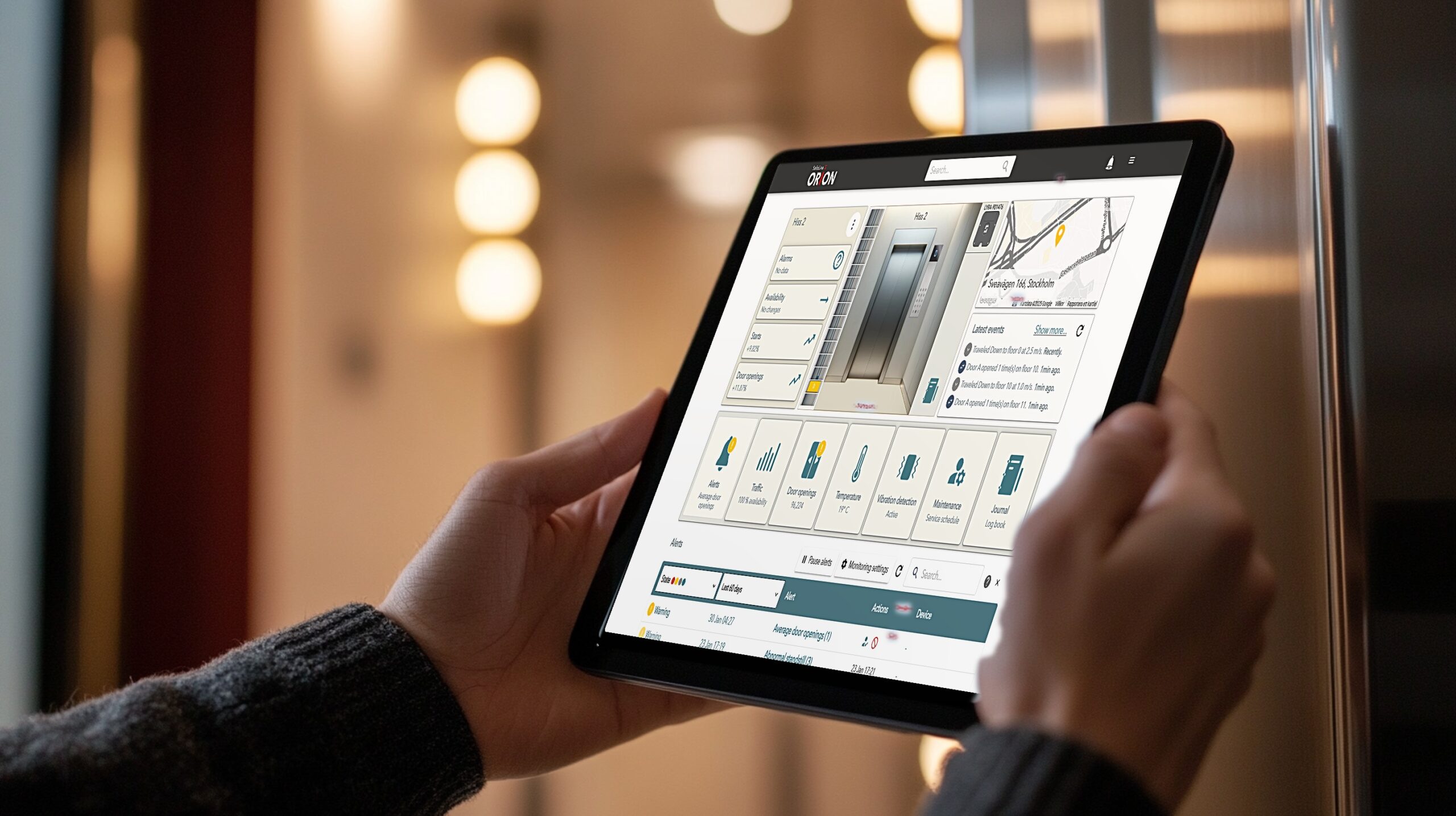
The most immediate change is operational coherence. A portfolio of mixed-brand lifts becomes a single dashboard. The same alert structure applies whether the lift was made by Otis, KONE, Schindler, TKE, or a regional manufacturer. The same compliance record covers the whole estate. The same performance metrics let you compare lift A to lift B objectively, regardless of who built either of them.
Beyond the dashboard view, five operational realities shift when monitoring stops being brand-tied:
- Portfolio benchmarking becomes meaningful. Lift performance can be compared across the estate using consistent metrics. Which buildings are running hot, which lifts have recurring fault patterns, which are quietly healthy – the comparison is objective because the measurement is identical.
- Service contracts become evaluable. When all monitoring data is held in one platform, the performance of different service providers across different buildings becomes directly comparable. The provider doing good work is visible; so is the one running the contract on autopilot.
- Acquisition and disposal become easier. When a building is added to the portfolio, LYRA installs in under an hour and the new lifts appear in the existing dashboard. When a building is sold, the data leaves with the owner – not the manufacturer.
- Compliance reporting becomes portfolio-level. EN81-28 3-day test calls log automatically across every lift, regardless of brand. Audit prep stops being a building-by-building reconciliation exercise.
- Manufacturer lock-in stops shaping decisions. Lift replacement, modernisation, and service procurement decisions can be made on operational merit, not on platform compatibility. The monitoring travels with the building, not the lift.
None of this requires displacing the existing service providers. Most building owners who add Orion continue with whichever service provider was already maintaining each lift. What changes is the information layer above the service relationship – and that change is what makes the service relationship work better, not worse.
Why this matters more in mixed portfolios
A property portfolio assembled over years of acquisitions rarely contains lifts from one manufacturer. A pension fund's real estate arm might hold offices, residential blocks, light industrial, retail – each acquired separately, each with whatever lift was already installed. A facilities management company managing third-party buildings will deal with whatever the building has.
In these portfolios, single-brand monitoring is not a partial answer. It is a structural mismatch. A platform that sees one lift in eight, or three lifts in twenty, does not produce a portfolio view at all. It produces a fragment.
The operational consequence is that, in mixed portfolios today, monitoring is often abandoned entirely. Why pay for a platform that only sees part of the picture? The result is that some of the most complex, highest-value lift portfolios run with the least visibility. The fragmentation has actively suppressed adoption of monitoring as a category.
Multi-brand monitoring changes that equation. The bigger and more heterogeneous the portfolio, the more value brand-independent monitoring delivers. It is precisely the buyers who could not justify a single-brand platform who get the highest return from Orion.
See your full portfolio in one place – book a demo →
Data ownership: the question beneath the platform question
The choice between manufacturer monitoring and independent monitoring is, at one level, a software comparison. At a deeper level, it is a question about who owns the operational record of your building.
When monitoring is tied to a lift manufacturer, the manufacturer holds the data. They decide what is reported, how it is presented, what is retained, and what is shared. If the building changes service provider – or if the building is sold – the historical record can become difficult to extract or transfer. The data lives in the manufacturer's ecosystem, not the building's.
With SafeLine Orion, the data belongs to the building owner. The platform delivers visibility; the record is yours. Service providers can be granted access at the level you choose. If the building changes hands, the data leaves with the owner. If the service contract changes, the history stays.
This is not a contractual subtlety. It is the foundation that makes everything else – portfolio benchmarking, service evaluation, compliance evidence, transparent operations – actually possible. Multi-brand monitoring only delivers its full value when the data ownership question is settled in the building owner's favour from the start.
This platform works alongside real-time lift monitoring and predictive maintenance– all three capabilities run from the same SafeLine Orion dashboard.
Part of the complete guide to lift monitoring– the topical hub covering real-time monitoring, predictive maintenance, and multi-brand monitoring from one platform.
Frequently asked questions
What features should I look for in a multi-brand lift monitoring system?
A multi-brand lift monitoring system should work on any lift regardless of manufacturer, controller, or age; install non-invasively without connecting to the lift’s control system; give the building owner full ownership of the data; and provide portfolio-level reporting across mixed fleets. SafeLine Orion meets these criteria. It uses SafeLine LYRA hardware installed on the lift car roof, observes the lift externally, and consolidates data from every connected lift into a single dashboard – irrespective of who manufactured each lift.
How does multi-brand lift monitoring improve building safety?
Multi-brand monitoring improves building safety by closing the visibility gap that exists in mixed-fleet portfolios. When some lifts are monitored by manufacturer platforms and others are not monitored at all, alert thresholds, response times, and compliance records are inconsistent across the estate. A brand-independent platform standardises monitoring across every lift, so the same fault detection, the same EN81-28 test call logging, and the same response protocols apply uniformly – regardless of which manufacturer originally built each lift.
What are the best platforms for monitoring multiple lift brands?
The best platforms for monitoring multiple lift brands are those that operate independently of any lift manufacturer. SafeLine Orion is purpose-built for this, working on any lift type through SafeLine LYRA hardware. The platform supports portfolio views across mixed fleets, automated EN81-28 compliance logging, and real-time alerts with configurable routing. Building owners retain full data ownership rather than handing it to a manufacturer-owned ecosystem.
Why should facility managers use multi-brand lift monitoring systems?
Facility managers responsible for mixed-fleet portfolios cannot reasonably operate from multiple manufacturer platforms in parallel. A multi-brand system consolidates monitoring, alerting, and compliance reporting into one tool. The operational benefit is that every lift in the estate is treated the same way: same alert thresholds, same fault history format, same audit trail. The job stops requiring building-by-building reconciliation.
How can lift maintenance companies integrate multi-brand lift monitoring?
Lift maintenance companies serving mixed-fleet customers can offer SafeLine Orion as a standard service layer regardless of which lift manufacturer is installed at each site. SafeLine LYRA installs in under an hour on any lift and does not require certification, approval, or technical cooperation from the lift’s original manufacturer. The maintenance company gains a uniform monitoring layer across its customer base, even when those customers have lifts from many different manufacturers.
Does multi-brand monitoring work on older lifts?
Yes. SafeLine LYRA is designed to work on lifts of any age – including lifts more than thirty years old. The sensor is installed externally on the car roof and does not require modern controllers, manufacturer support, or upgraded electrical systems. Older lifts are often where multi-brand monitoring delivers the most operational value, because they are typically the ones for which no manufacturer monitoring platform is available at all.
How does multi-brand monitoring affect the existing service contract?
Multi-brand monitoring sits alongside the existing service contract rather than replacing it. The service provider continues to deliver scheduled maintenance and respond to faults. What changes is that the building owner has independent visibility into what is happening on the lift between visits, an automatic record of every service event, and the ability to compare service performance objectively across providers and buildings. In practice, service relationships usually improve, because both parties work from the same data.
Is multi-brand lift monitoring a cybersecurity risk?
No. SafeLine LYRA installs on the lift car roof and has no connection to the lift’s control system. SafeLine Orion observes lift operation but has no path into the lift’s core functions, regardless of which manufacturer built the lift. There is no command interface, no integration with controller firmware, and no attack surface that could affect lift safety. The platform is NIS2-aligned and GDPR-compliant by design.
Want to learn more about SafeLine Orion?