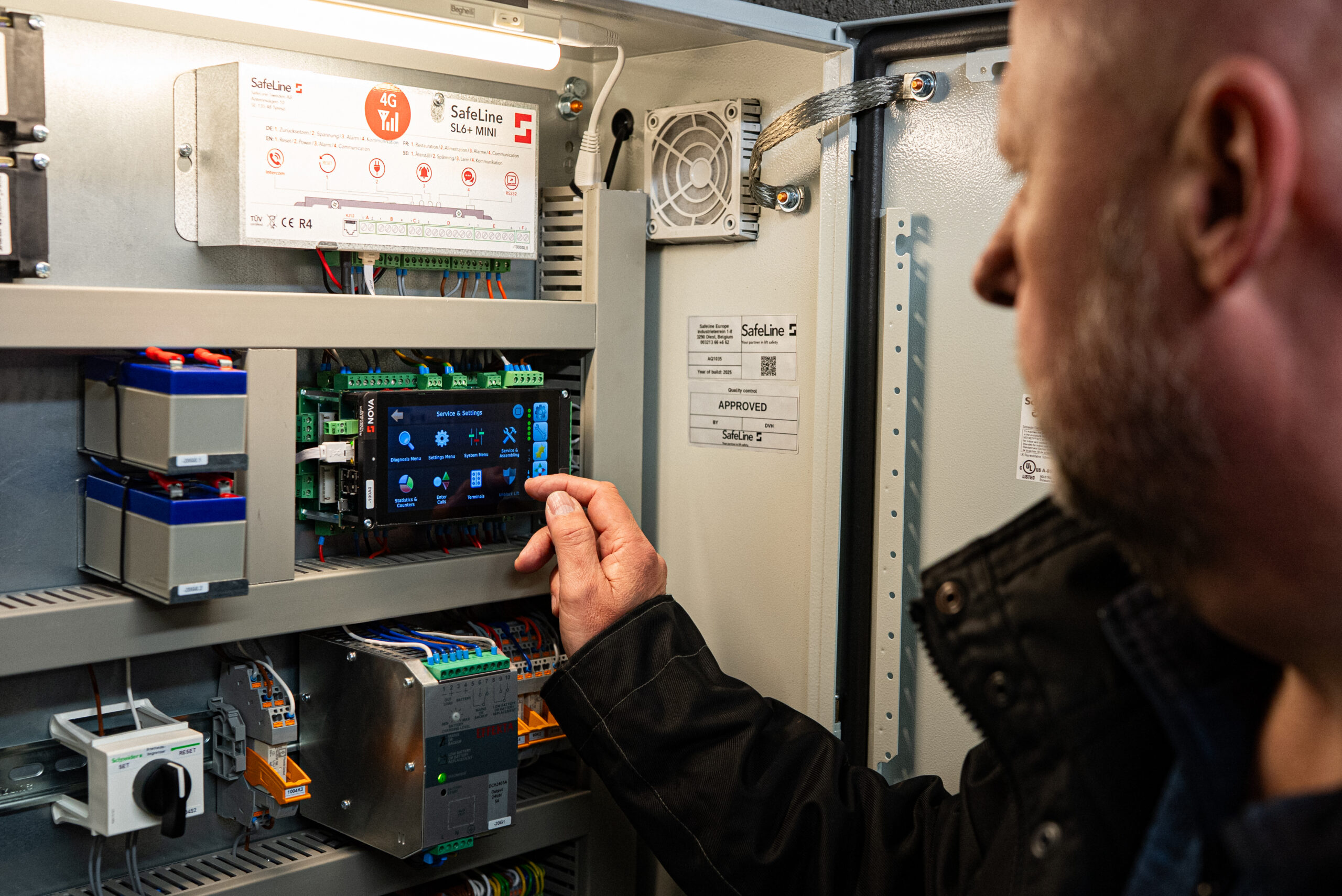
What is the Radio Equipment Directive (RED)?
Does RED apply to lift emergency telephones?
- Emergency telephones and auto-diallers with a 2G/3G/4G/VoLTE connection;
- Managed SIM-based communication units;
- Wireless intercoms and radio-linked landing stations;
- Bluetooth commissioning and configuration tools (for example, setting up a unit from an installer's phone).
What must a compliant lift emergency telephone do?
| Article | Requirement |
|---|---|
| 3.1(a) | Protection of the health and safety of people and property |
| 3.1(b) | An adequate level of electromagnetic compatibility (EMC) |
| 3.2 | Effective use of the radio spectrum, to avoid harmful interference |
| 3.3 | Additional requirements the European Commission can activate for specific categories of equipment. Since 1 August 2025, the cybersecurity requirements (3.3(d) to (f)) apply to network-connected radio equipment. |
The RED cybersecurity requirements from 1 August 2025
- Article 3.3(d) – the equipment must not harm the network or its functioning;
- Article 3.3(e) – safeguards for the protection of personal data and privacy;
- Article 3.3(f) – protection from fraud.
How RED fits with EN 81-28 and EN 81-72
- RED / Radio Equipment Regulations 2017 govern the equipment: may the radio device be sold, is it safe, compatible and (in the EU) cyber-secure?
- EN 81-28 governs the function: the lift emergency alarm must provide two-way voice communication and an automatic test call at least every 72 hours. See our EN 81-28 compliance guide.
- EN 81-72 governs firefighter-lift communication in buildings that require it.
UK and EU: CE, UKCA and the Radio Equipment Regulations 2017
- Selling into the EU/EEA: CE marking under RED 2014/53/EU, including the August 2025 cybersecurity requirements.
- Selling into Great Britain: CE or UKCA marking under the Radio Equipment Regulations 2017.
How to check your lift emergency telephone is compliant
- Look for a CE mark (EU and Great Britain) or a UKCA mark (Great Britain) on the unit.
- Ask the supplier for the Declaration of Conformity and keep it on file – it lists the directives/regulations and standards the product was assessed against.
- For network-connected units placed on the EU market from August 2025, check that cybersecurity (RED 3.3) is addressed, typically via EN 18031.
- Confirm the unit is also EN 81-28 capable (two-way voice, automatic test calls).
- Do not modify the housing or antenna in a way that could affect radio performance – this can invalidate the Declaration of Conformity.
Frequently asked questions
Is a lift emergency telephone classed as radio equipment?
Yes, if it connects over a mobile network. A lift emergency telephone that uses a 2G, 3G, 4G or VoLTE connection contains a cellular radio module, which makes it radio equipment under the EU Radio Equipment Directive (2014/53/EU) and the UK Radio Equipment Regulations 2017. A purely wired PSTN telephone with no radio transmitter is not radio equipment, but those units are being retired as the PSTN is switched off.
Does RED apply to lift emergency telephones after the PSTN switch-off?
More than before. As lines move from the analogue PSTN to mobile networks, most replacement lift emergency telephones use a cellular connection and therefore fall squarely under RED (EU) or the Radio Equipment Regulations 2017 (UK). The move to 4G/VoLTE makes radio-equipment compliance a core requirement of the upgrade, not an afterthought.
What is the difference between RED and EN 81-28?
They govern different layers. RED (and the UK Radio Equipment Regulations 2017) require that the radio equipment itself is safe, electromagnetically compatible, uses the spectrum correctly and, since August 2025 in the EU, meets cybersecurity requirements, so it may be placed on the market. EN 81-28 is the functional lift standard that defines what the emergency alarm system must do, such as providing two-way voice communication and an automatic test call at least every 72 hours. A compliant lift emergency telephone must satisfy both.
Do the RED cybersecurity requirements from August 2025 apply to lift emergency telephones?
Typically yes for equipment placed on the EU market. Delegated Regulation (EU) 2022/30 activated Articles 3.3(d), (e) and (f) of RED from 1 August 2025, covering network protection, personal-data and privacy safeguards, and protection from fraud. A network-connected lift emergency telephone that carries voice calls usually falls within 3.3(d) and 3.3(e). Conformity is commonly shown against the harmonised standards EN 18031-1, -2 and -3.
Does RED apply in the UK after Brexit?
In Great Britain the equivalent law is the Radio Equipment Regulations 2017, and Great Britain accepts either the CE or the UKCA mark. It carries across the same essential requirements as the EU RED. Products sold into the EU still need CE marking under RED, including the August 2025 cybersecurity requirements. UK product-security rules are evolving, so confirm the current UK obligations for your specific product.
Who is responsible for RED compliance, the manufacturer or the building owner?
The manufacturer or importer is responsible for placing compliant radio equipment on the market, affixing the CE or UKCA mark and issuing a Declaration of Conformity. Building owners and lift companies should specify equipment that carries the correct marking, keep the Declaration of Conformity on file, and avoid modifying the housing or antenna in a way that could affect radio performance.
Does a lift emergency telephone need UKCA marking?
In Great Britain a mobile-connected lift emergency telephone is radio equipment under the Radio Equipment Regulations 2017. It needs either the UKCA mark or the CE mark, because Great Britain recognises CE marking indefinitely. Units placed on the EU market need CE marking under RED. Non-radio lift components with no transmitter fall outside these rules.
Which harmonised standards apply to RED for a lift emergency telephone?
Manufacturers use harmonised standards to give a presumption of conformity. For a cellular lift telephone this typically includes EMC standards for radio (for example the EN 301 489 series), the relevant radio standards for the cellular bands (such as EN 301 511 for GSM and EN 301 908 for 4G/LTE), a safety standard, and, for the August 2025 cybersecurity requirements, EN 18031-1, -2 and -3. The exact standards are listed in the product’s Declaration of Conformity.